
This event is sponsored by The Robert H. N. Ho Family Foundation Program in Buddhism and Contemporary Society at the University of British Columbia, Vancouver, with generous support of the International Association of Shin Buddhist Studies (IASBS).
本イベントは、RHNHFF BCSプログラムの主催、および国際真宗学会(IASBS)のご支援により開催されます。
Event Date: Thu, August 06, 2026 | Time: 7:00 – 9:00 PM PT | Location: Walter Gage UBC – Multimedia Room
日時: 2026年8月6日(木) | 時間: 19:00-21:00(太平洋時間 / PT)| 会場: マルチメディアルーム | ゲイジ
This event is hybrid, free and open to the public, and can be attended in person or online via Zoom. Registration required.
本イベントはハイブリッド形式(対面およびZoomによるオンライン配信)で開催され、参加費無料でどなたでもご参加いただけます。事前の参加登録が必要です。
This keynote is part of the academic Conference, Pure Land Buddhism and the Great Earth
本基調講演は、学会「浄土教と大地(Pure Land Buddhism and the Great Earth)」の一環として開催されます。
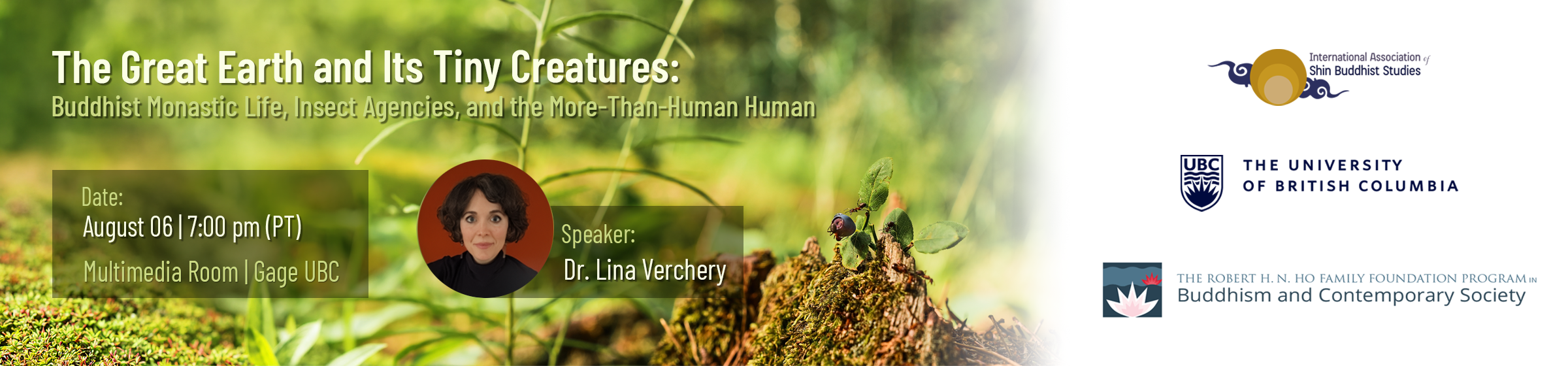
The Great Earth and Its Tiny Creatures: Buddhist Monastic Life, Insect Agencies, and the More-Than-Human Human
「大地とその小さな生き物たち:仏教の出家生活、昆虫のエージェンシー(能動性)、そして〈More-than-Human〉としての人間」
About this Event | イベント概要
Animated by a call to urgently rethink our relationship with the nonhuman world in light of compounding ecological crises, scholarly work across a variety of fields—including the study of Buddhism and Asian religions—has begun to acknowledge that what it means to be human is inextricably determined by our relations with the more-than-human world. While work in this area has inspired new attention to the lifeworlds of plants, fungi, nonhuman animals, and complex ecosystems, much of it still unwittingly centers the very anthropocentric epistemes it attempts to displace.
深刻化する環境危機に直面し、非人間世界との関係性を緊急に再考せざるを得ない現代において、仏教やアジア宗教の研究を含む多様な学術分野で、「人間であること」の意味は「人間を超えた世界(more-than-human world)」との関係性によって不可分に決定されているという認識が広まりつつあります。この領域の研究は、植物、菌類、非人間動物、および複雑な生態系の生命世界への新たな関心を呼び起こしてきましたが、その多くは、打破しようとしているまさに「人間中心主義的な知の枠組み」を、無自覚に前提としてしまっています。
Drawing on ethnographic fieldwork conducted with the Dharma Realm Buddhist Association in Taiwan—a Chinese monastic community heavily steeped in Pure Land practice—this talk explores how Buddhist scriptures, commentaries, and the everyday practices of monastic life offer conceptual resources that challenge human-centered ways of knowing. Taking up the specific case of Buddhist engagement with insects (chong 蟲)—those tiny creatures who so powerfully defy anthropocentric relatability—I argue that the alterity of insects has made them an exceptionally productive site for moral reflection beyond the human, not only within the relatively recent more-than-human turn in academia but across the vast historical landscape of Chinese religion, literature, and thought.
本講演では、浄土信仰が深く根付いている台湾の中国仏教出家コミュニティで行ったエスノグラフィーフィールドワークに基づき、仏教の経典や注釈書、そして出家生活の日常的な実践が、いかにして人間中心的な知のあり方に揺さぶりをかける思考資源を提供しているかを探ります。特に、人間中心的な理解や共感が及びにくい存在である「昆虫(蟲)」への仏教的な関わりに焦点を当てます。昆虫という他者の存在は、近年のアカデミアにおける「more-than-human」への転回のみならず、中国の宗教・文学・思想の広大な歴史全体を通じて、人間の枠を超えた道徳的省察を促すきわめて豊かな考察の場であり続けてきた、と私は論じます。
This talk thus attends not only to the question of the Buddhist insect imaginaire—namely, the way humans have imaginatively constructed ideas about insects and used those as a lens through which to understand Buddhist ideas like rebirth, karma, and cosmology —but also, and most importantly, the question of how insect agents themselves have been implicated in the cocreation of Buddhist ideas. The human imagination, I argue, is inseparable from the more-than-human world that co-constitutes the conditions of its possibility. While this leads to philosophical insights that resonate with emerging postmodern and even metamodern thought—such as actor-network theory, New Materialisms and Object-Oriented Ontologies, agential realism, ecosemiotics, post-humanism, and so on—we shall see that many of these “cutting-edge” theoretical innovations actually recapitulate ideas that have long been robustly theorized in the Buddhist tradition.
したがって本講演では、仏教における昆虫の「イマジネール(想像界)」――すなわち、人間が昆虫についていかに想像的に概念を構築し、それらを輪廻、業(カルマ)、宇宙観といった仏教的思想を理解するためのレンズとして用いてきたか――という問いに留まりません。最も重要なのは、昆虫という能動的な主体(エージェント)そのものが、いかにして仏教思想の共同創造に関与してきたかという問いです。人間の想像力は、その可能性の条件を共に構成している「人間を超えた世界」と切り離すことはできない、と私は考えます。このアプローチは、アクターネットワーク理論、ニュー・マテリアリズム(New Materialisms)、オブジェクト指向存在論(OOO)、エージェンシャル・リアリズム(agential realism)、環境記号論、ポスト・ヒューマニズムなど、現代のポストモダンやメタモダンの新興思想と共鳴する哲学的な洞察を導き出しますが、同時に、こうした「最先端」とされる理論的革新の多くが、実は仏教の伝統において古くから力強く理論化されてきた思想をあらためて示しているにすぎないことを見ていくことになるでしょう。
About the Speaker | 登壇者紹介

Lina Verchery 黎娜 is a filmmaker and scholar of Buddhism. She holds a PhD in Buddhist Studies from Harvard University’s Committee on the Study of Religion and an M.Div. in Buddhism from Harvard Divinity School. A trained ethnographer, her areas of research and teaching include contemporary Chinese Buddhism and Buddhist monastic life, as well as the intersections of Buddhism and art, interspecies ethics, and environmental anthropology. She is a full member of the National Coalition of Independent Scholars, prior to which she was Senior Lecturer at Victoria University of Wellington in Aotearoa New Zealand. She has also taught at the University of Otago and Union College. An award-winning filmmaker, her documentary films about Buddhism and connected topics have been screened in festivals and on television networks around the world.
リナ・ヴァーシェリー(Lina Verchery / 黎娜):映画監督、仏教研究者。ハーバード大学Committee on the Study of Religionにて仏教研究の博士号(PhD)、ハーバード神学大学院にて仏教研究の神学修士号(M.Div.)を取得。専門的な訓練を受けたエスノグラファーとして、現代中国仏教、仏教の出家生活、さらには仏教と芸術の交差、種を超えた倫理(インタースピーシーズ・エシックス)、環境人類学などをテーマに研究・教育活動を行っている。全米独立研究者連合(NCIS)の正会員。それ以前は、アオテアロア(ニュージーランド)のヴィクトリア大学ウェリントンにて上級講師を務めた。また、オタゴ大学やユニオン・カレッジでも教えた経歴を持つ。受賞歴のある映画監督でもあり、仏教や関連テーマを扱ったドキュメンタリー映画は、世界各地の映画祭やテレビ局で上映・放映されている。
